
Gabapentinoids Are Weird, Sometimes Useful, and Often Overused
Mechanism, dosing, renal adjustment, toxicity, misuse, and the clinical scenarios where gabapentinoids actually help.


TL;DR
Gabapentinoids are useful drugs, but they are not harmless “low-risk” pain meds.
They work best for true neuropathic pain, where alpha-2-delta-1 calcium channel upregulation is part of the biology.
Gabapentin has saturable absorption and diminishing returns at higher doses; pregabalin is more predictable but has higher misuse potential.
Both require renal dose adjustments, can accumulate and cause a neurotoxic syndrome, can cause withdrawal, and increase respiratory depression risk when combined with opioids or other sedatives.
Use them when the pain syndrome fits the drug’s mechanism, dose them appropriately based on renal function and other risks, and don’t escalate indefinitely.
Gabapentinoids are everywhere, but not benign
They feel safer than opioids, less intimidating than a TCA, and easier to prescribe than other alternatives. But gabapentinoids are not benign enough to be used liberally for the “just in case it works” pain.
They have unusual absorption, unpredictable dose-response, renal accumulation, dose-limiting neurotoxicity, withdrawal syndromes, misuse potential, and evidence of respiratory depression when combined with opioids and/or other sedatives. They are also genuinely useful when the pain syndrome is neuropathic, and the drug is dosed with its pharmacology in mind.
Understanding the mechanism explains when it works, when it does not, and why pushing the dose higher often stops making sense.
“Gabapentinoid” is a misnomer.
Despite being structural analogs of GABA, they do not act on GABA receptors at all and instead bind the alpha-2 delta-1 subunit of presynaptic voltage-gated calcium channels. This binding in the CNS reduces calcium influx and dampens release of excitatory neurotransmitters (such as glutamate, substance P, and norepinephrine) into the dorsal horn.
Gabapentin was approved in 1993 for epilepsy, and the neuropathic pain use was a later development. Pregabalin is the S-enantiomer of 3-isobutyl-GABA and was engineered as a successor to gabapentin.
This class of drugs is particularly effective for neuropathic pain because peripheral nerve injuries lead to the upregulation of the alpha-2 delta-1 subunits in the dorsal root ganglia.
Why gabapentin dosing is weird
Its absorption is non-linear, meaning that the bioavailability falls as the dose rises. Thus, giving higher doses leads to diminishing returns.
Gabapentin is absorbed only via an L-amino acid transporter in the proximal small bowel, and this transporter is saturable. At 900 mg a day, bioavailability of gabapentin is about 60%. At 3,600 mg a day, this drops to 33%.
Gabapentin’s half-life is only 5 to 7 hours. Spacing out doses more than 12 hours apart leads to diminishing returns. This is why TID dosing is the norm, and you can’t rely on one single large dose to get through the day.
There is little point in going above doses of 1800 to 2400 mg/day for most indications. Most neuropathic pain patients plateau around 1800 mg/day. The variable bioavailability explains why the dose response is unpredictable between patients.
Starting doses (in those with healthy kidneys) are usually:
300mg qhs on day 1
300mg BID on day 2
300mg TID on day 3
From there, you can increase each dose by 100mg with a general “target” of 1800mg/day divided into TID doses.
Why pregabalin is more predictable
In contrast, pregabalin is rapidly and completely absorbed (it is also taken up in the proximal colon). It also has a flat, predictable bioavailability of over 90% across the entire dose range. It has peak levels at one hour compared to three hours for gabapentin, so it works quicker. It also has roughly six times higher binding affinity for the alpha-2 delta-1 receptor than gabapentin. Altogether, this translates to more reliable dosing, a faster onset of analgesia, and easier titration.
However, the flip side is that this rapid and high bioavailability is what gives pregabalin a higher abuse and dependence potential. This is why pregabalin is a DEA Schedule V controlled substance while gabapentin is not federally scheduled (although several states now schedule it or track it via their PDMP).
Starting doses are usually:
50mg TID or 75mg BID
Titrated up to general goal of 300mg/day within 1 week.
Alternatively, you can start with 25-50mg qhs in elderly patients.
Like with gabapentin, you shouldn’t chase the max dose. For most use-cases, 300 mg/day captures essentially all of the efficacy.
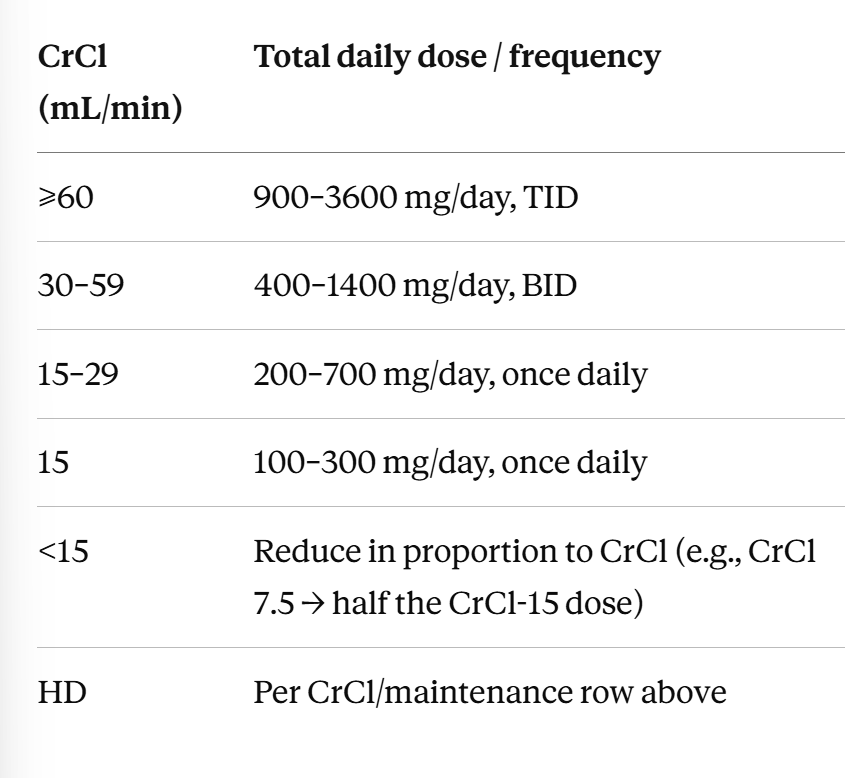
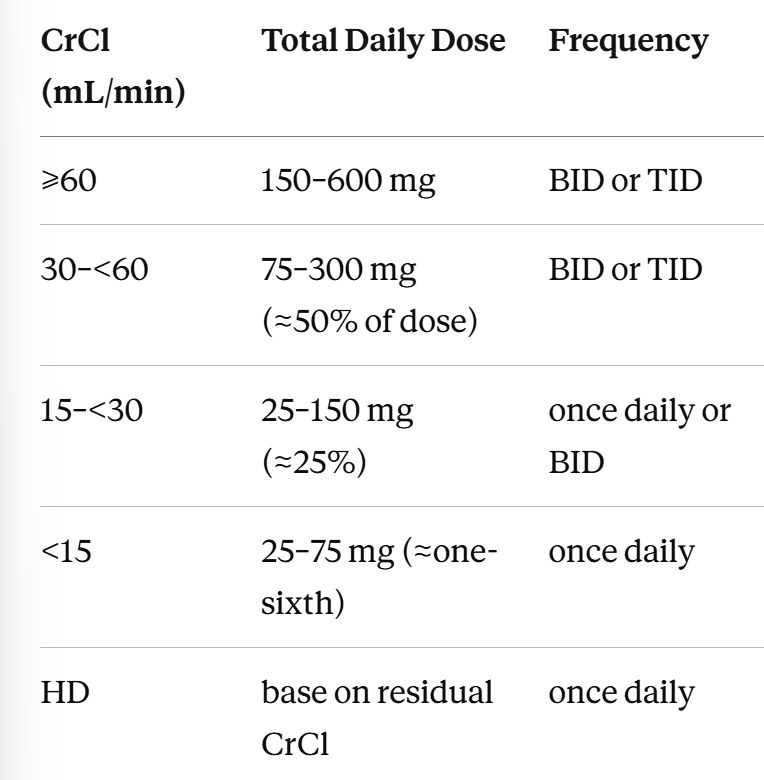
Both drugs are eliminated unchanged by the kidneys; renal impairment causes accumulation and neurotoxicity
Neither drug is hepatically metabolized, protein bound, or a CYP substrate/inhibitor. While this means there’s no major drug “interactions”, it also means they have to be dose-adjusted for renal impairment.
There is also an increased risk of level accumulation, which can produce a toxidrome of somnolence, confusion, ataxia, and myoclonus.
On the wards, this is a frequently missed cause of unexplained altered mental status in those with an AKI and in the elderly.
Gabapentinoids have a low volume of distribution and are effectively cleared with dialysis. In patients with ESRD, a post-dialysis supplement of 125-350mg is commonly given after each 4 hours HD session.
For gabapentin:
For pregabalin:
Gabapentinoids can cause life-threatening respiratory depression, especially when given concomitantly with opioids or other CNS depressants
An FDA communication in 2019 described serious breathing problems with gabapentin/pregabalin in patients with respiratory risk factors, especially opioid/CNS depressant use, COPD/reduced lung function, and older age. This was based on case reports between 2012 and 2017 in which twelve people died of respiratory depression.
This is why it’s important to start low, avoid stacking with benzos, opioids, or sedating antihistamines, and be cautious in the elderly and those with reduced lung function.
There are numerous dose-limiting toxicities and a serious withdrawal syndrome
Common side effects include sedation, dizziness, ataxia, peripheral edema, and weight gain. The classically associated peripheral edema is diuretic resistant. All together, these side effects can drive falls and fractures in older patients.
Abrupt discontinuation can precipitate withdrawal syndrome, including anxiety, insomnia, diaphoresis, and even seizures in those at risk. It resembles benzo/alcohol withdrawal in high dose / long-term users.
Thus, these medications should be tapered over at least 1 week. Longer tapers are often needed for high-dose, long-term use or patients with seizure risk.
There are several genuine FDA-approved and off-label uses
FDA-approved evidence-supported indications for both gabapentin and pregabalin include post-herpetic neuralgia and partial-onset seizures.
Pregabalin is also approved for use in diabetic peripheral neuropathy (first line), fibromyalgia, and spinal cord injury neuropathic pain.
Gabapentin enacarbil (Horizant) is an extended-release prodrug that is FDA-approved for restless leg syndrome and has some benefits over dopamine agonists since they do not lead to augmentation of symptoms. This long-acting medicine was engineered specifically to bypass gabapentin’s saturable absorption.
Some of the more common off label uses for gabapentin includes refractory chronic cough or hiccups, and uremic/chronic pruritus.
The unifying principle is that these drugs are valuable when pain is genuinely neuropathic and driven by the alpha-2 delta-1 upregulation.
One thing nice about gabapentinoids is that analgesic onset can occur within the first week, unlike many other neuropathic agents (like SNRIs or TCAs) that can take weeks to work.
But gabapentin is often used inappropriately
Routine use of gabapentinoids for perioperative pain is not supported in the literature. They are also largely ineffective for sciatica and nonspecific low back pain. In one trial, pregabalin was no better than placebo and caused more side effects over an 8-week period (NEJM, 2017). Even when symptoms sound “nerve-like,” pregabalin was no better than placebo for acute or chronic sciatica.
It fits mechanistically because radicular (from intermittent nerve compression and not chronic nerve damage) and mechanical back pain are not due to the up-regulated alpha-2 delta-1 driven neuropathic state that these drugs target.
As an aside, gabapentin was at the center of a landmark off-label marketing fraud case, which is one reason physicians believed (and still believe) there was evidence for its use in many other unapproved conditions.
Very interesting!!